

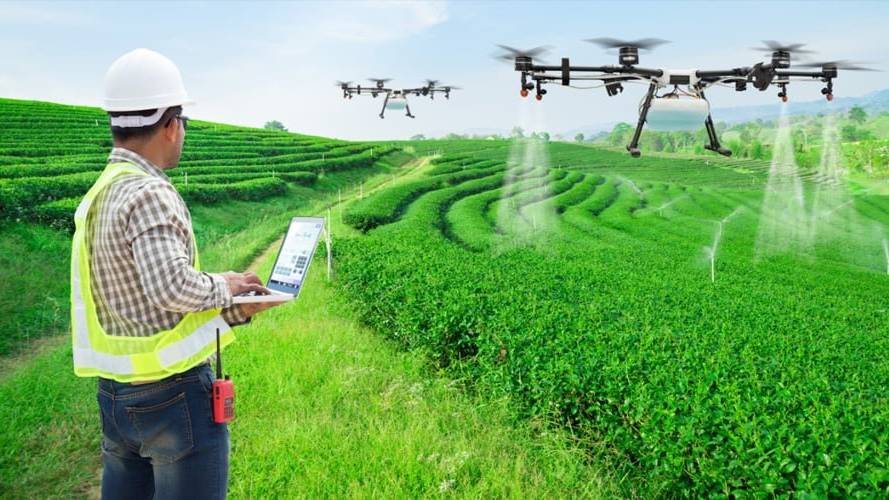
Farming is changing in a big way across Canada’s farmlands. It’s not the kind of farming our grandparents knew. Today, farmers are using advanced tools like AI and drones alongside tractors and irrigation systems.
More and more farmers are turning to these tools to deal with tough issues like worker shortages, unpredictable weather, and the growing demand to produce more food using fewer resources. These new technologies are transforming how we grow our food and care for the land.
Smart Decision-Making with AI
In times past, farmers relied on intuition and experience to make important decisions. Today, artificial intelligence systems analyze millions of data points to provide insights that would be impossible for humans to calculate alone.
Take British Columbia’s blueberry farmers, for instance. They’re now employing AI systems paired with drones to detect the devastating Blueberry Scorch Virus (BIScV) before visible symptoms appear. This early detection system has dramatically reduced crop losses and treatment costs while improving yields in affected regions.
Another success story comes from Saskatchewan, where farmers using AI-powered soil analysis have optimized fertilizer application, reducing input costs by nearly 30% while maintaining or even increasing yields. These systems map soil nutrients with pinpoint accuracy, ensuring that each section of a field receives exactly what it needs. No more, no less.
Eyes in the Sky: How Drones are Changing Canadian Farming
The drone revolution in Canadian agriculture has been nothing short of remarkable. These flying machines have evolved from novelty gadgets to essential farming tools in just a few years.
While aerial imaging remains a core function, today’s agricultural drones do far more than take pictures. Modern farm drones can:
- Create detailed 3D maps of fields with centimeter-level precision
- Analyze plant health using multispectral and thermal imaging
- Monitor livestock across vast rangelands
- Identify water stress before it becomes visible to the human eye
- Target specific weeds or pest-affected areas for treatment
Regulatory Hurdles and Progress
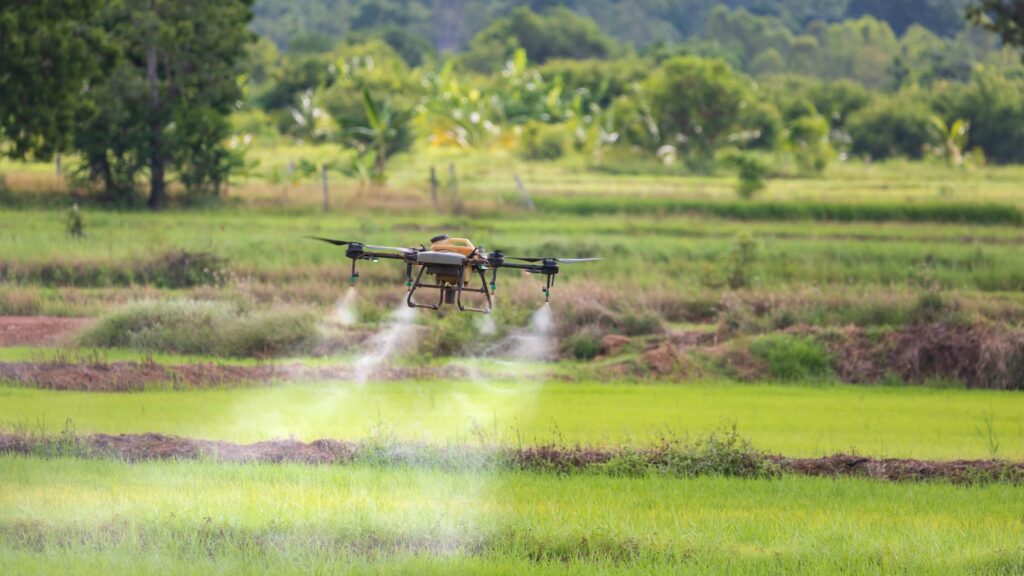
Despite their potential, drone applications in Canadian agriculture face regulatory challenges. Currently, spraying pesticides from drones remains illegal in Canada, though this may soon change.
“It is currently illegal to spray pesticides from a drone in Canada, whether it is on your property or not,” reports Sprayers 101, highlighting ongoing regulatory hurdles. However, the industry is actively working with Health Canada to develop protocols that would allow this practice safely and effectively.
Recent progress offers hope. “Work is ongoing to satisfy Canada’s regulatory authorities and get drones added to pesticide labels for agricultural spraying,” notes Manitoba Cooperator, suggesting that changes may be on the horizon.
Real-World Success: AI and Drones in Action
The real test of any technology lies in practical applications. Across Canada, numerous case studies demonstrate the tangible benefits of these advanced farming tools.
Case Study: Precision Seeding in Alberta
An innovative farming operation in Alberta has implemented AI-guided autonomous tractors for precision seeding. Using soil composition data and historical yield information, the AI system optimizes seed spacing and depth for each field section.
The results? A 15% increase in germination rates and an estimated 12% boost in overall yield compared to traditional methods. Additionally, the operation reported a 20% reduction in fuel consumption. A significant cost savings that also reduces their carbon footprint.
Case Study: Drone-Based Pest Management in Ontario
Apple orchards in Ontario have pioneered the use of drones equipped with multispectral cameras to identify early signs of fire blight and other orchard diseases. The imaging technology can detect infection hotspots up to two weeks before they become visible to human scouts.
By enabling targeted treatment of only affected areas, this approach has:
- Reduced pesticide use by 40%
- Decreased labor costs by 35%
- Minimized environmental impact
- Improved fruit quality and yield
“Canadian farmers using satellite imagery for crop management have seen up to 20% increase in yield efficiency,” points out industry reports, highlighting the impressive results of adopting these technologies.
The Environmental Upside
Beyond efficiency and productivity gains, AI and drone technologies are proving to be powerful allies in sustainable farming efforts.
Precision Resource Management
Traditional farming often involves blanket applications of water, fertilizer, and pesticides. In contrast, precision agriculture enabled by AI and drones allows for targeted resource use, significantly reducing waste and environmental impact.
In the Canadian Prairies, farmers using precision irrigation guided by drone-gathered moisture data have reduced water usage by up to 25% while maintaining crop health, a critical advantage in regions experiencing increasing drought conditions.
Supporting Regenerative Practices
AI systems are helping Canadian farmers implement and manage regenerative agriculture practices more effectively:
- Monitoring soil carbon sequestration rates across different management approaches
- Optimizing cover crop selection and planting timing
- Tracking biodiversity improvements from field margins to waterways
- Quantifying environmental benefits for carbon credit programs
“Canadian farmers using precision agriculture techniques can reduce input costs by up to 30% while increasing crop yields by 20%,” notes research from Farmonaut, demonstrating both economic and environmental benefits.
Challenges and Path Forward
Despite impressive advances, widespread adoption of AI and drone technology in Canadian agriculture faces several obstacles.
Connectivity and Infrastructure
Many rural Canadian farming communities still lack reliable high-speed internet access, a prerequisite for many AI-powered farming solutions. The federal government has pledged to achieve 98% connectivity across Canada by 2026, but the last mile often proves the most difficult.
Cost Barriers and Knowledge Gaps
Advanced agricultural technology requires significant investment. While large operations can often justify the expense through scale, smaller family farms may struggle with initial costs despite the long-term benefits.
Additionally, effectively using these technologies requires new skills. Organizations like Agriculture and Agri-Food Canada are expanding training programs to help farmers transition to these digital tools, but education remains a challenge in remote areas.
Data Ownership and Privacy
As farming becomes more data-driven, questions around who owns and controls agricultural data have grown increasingly important. According to research from the University of Saskatchewan, “The lack of transparency around issues such as data ownership, portability, privacy, and liability has resulted in farmers being reluctant to share their farm data.” This hesitation could potentially slow adoption of connected farming technologies.
Emerging Technologies on the Horizon
Several promising developments are likely to shape Canadian farming in the coming years:
- AI-driven predictive analytics that forecast disease outbreaks and market conditions with increasing accuracy
- Drone swarms that can manage large-scale operations simultaneously
- Edge computing systems that allow AI processing directly in the field, even with limited connectivity
- Autonomous equipment networks where drones coordinate with ground-based robots for end-to-end farming operations
- Blockchain integration for transparent supply chain tracking from seed to consumer
Collaborative Innovation
What’s particularly encouraging is the collaborative approach emerging across Canada’s agricultural sector. Universities, private companies, government agencies, and farmers themselves are forming partnerships to accelerate practical innovation.
At the University of British Columbia Okanagan, for instance, researchers are developing AI systems and robotics that work alongside drones to address wildfire monitoring and agricultural challenges simultaneously, an integrated approach to rural land management.
A Smart Farming Future
The marriage of artificial intelligence and drone technology represents nothing less than a paradigm shift for Canadian agriculture. Far from replacing farmers or traditional knowledge, these tools are amplifying human expertise and extending what’s possible on Canadian farms.
As regulatory frameworks evolve and technology becomes more accessible, expect to see continued transformation across Canada’s agricultural landscape. The farms of tomorrow will likely bear little resemblance to those of previous generations. It will be more efficient, more sustainable, and more technologically sophisticated.
For Canadian farmers willing to embrace these changes, the future holds tremendous promise, such as increased productivity, reduced environmental impact, lower operating costs, and potentially more satisfying work as AI and drones handle repetitive tasks while humans focus on strategy and stewardship.
The seeds of this agricultural revolution have been planted. Now, we watch them grow.