


Techsoma
Latest Startups AI Innovation Startups Global Policy Opinions Events
Global News Innovation in Canada Tech Trends for Canada Reports Canadian Startup Ecosystem AI Innovation in Canada Black and Diverse Tech Founders Global News Tech Policy in Canada Opinions Event Radar
Techsoma Canada
  • About
  • Advertise
  • Privacy & Policy
  • Contact
No Result
View All Result
Techsoma
  • About
  • Advertise
  • Privacy & Policy
  • Contact
No Result
View All Result
Techsoma
No Result
View All Result
Home Opinions

How a Single Graph of Replit’s Growth Revealed a Masterclass in Strategy

by Kingsley Okeke
November 7, 2025
in Opinions
Reading Time: 5 mins read
Replit's Growth Curve

I came across a tweet recently showing Replit’s growth graph, a near-vertical curve that instantly caught my attention. It wasn’t just another tech success story; it was a lesson in how smart product design and timing can power explosive scale. That graph represented years of deliberate choices: lowering barriers to entry, building community momentum, and layering AI in a way that actually mattered.
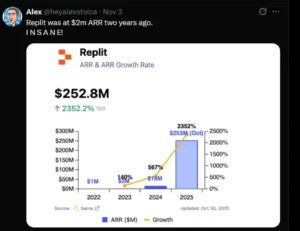
Replit's Growth Curve
The tweet showing Replit’s growth.

As I dug deeper into Replit’s story, it became clear that their rise wasn’t luck. It was a playbook that other startups (especially those chasing sustainable growth) could learn from.

From a Browser Tool to an AI Platform

Replit started as a browser-based IDE built on a simple idea: make coding as easy as opening a webpage. No downloads, no installations, no setup headaches. That low-friction model made it a natural fit for students, educators, and developers testing quick ideas. Each small decision reinforced the same goal of keeping users inside the product.

Then came the real inflection. In 2024, Replit moved beyond being just a coding platform and integrated AI directly into the creative process. Ghostwriter, its AI assistant, and later, AI agents that could generate entire applications, turned Replit into a coding ecosystem, a place where development and automation converged.

By 2025, the company had raised $250 million at a $3 billion valuation. But what stood out wasn’t just the funding; it was how they earned it, by scaling through community, utility, and intelligence.

The Anatomy of Replit’s Strategy

After looking at that growth curve, I realised the company’s success rests on a few principles that can be imitated, not copied exactly, but adapted intelligently.

1. Start With Zero Friction
Replit’s onboarding takes seconds. The product removes every possible hurdle between curiosity and creation. That simplicity converts browsers into users and users into regulars. For other startups, the question is: how fast can someone experience the core value of your product?

2. Let the Community Market the Product
Replit’s users build apps, share code, and teach others. Every shared project is a marketing channel in disguise. A strong community builds itself when participation feels rewarding and visible.

3. Add AI as a Multiplier, Not a Decoration
Replit didn’t bolt on AI for hype; instead, it embedded AI into real workflows. Ghostwriter made coding faster, and AI agents made app creation easier. The key lesson is to integrate AI where it directly amplifies what users already do.

4. Mix Free Access With Smart Monetisation
Replit balances a massive free tier with paid plans for advanced compute and AI use. The hybrid model converts curiosity into revenue without breaking accessibility. It’s a strategy that lets the product grow before it monetises heavily.

5. Grow Through Education
Replit found one of the most sustainable growth channels: classrooms. Teachers introduced it to entire cohorts of students, turning education into a distribution. For any tech company, an institutional foothold is often more powerful than advertising.

6. Move Upmarket Once the Base Is Solid
Only after building trust with individuals did Replit roll out enterprise-grade features, private workspaces, team billing, and security tools. Growth first, enterprise later.

Lessons for Other Startups

Startups often chase viral growth or complex AI products before perfecting the basics. Replit’s story shows that scaling sustainably starts with simplicity. Its core loop (fast access, visible progress, and community validation) is the foundation. Everything else, including AI, came later to multiply what already worked.

Here’s how others can follow the path:

  1. Create a straightforward product that provides immediate value.

  2. Foster a community where sharing and feedback are natural.

  3. Introduce AI where it reduces friction or boosts creativity.

  4. Use hybrid pricing to capture both reach and revenue.

  5. Find a niche distribution channel (such as education or creators) to spread organically.

Why It Works

Replit’s growth was forged at the intersection of two major shifts: the demand for accessible coding tools and the rise of practical AI. It met both needs with precision. The product was both easy and empowering to use. That combination, visible in that steep growth graph I saw on X, is what most startups miss.

Final Thought

Replit’s growth curve tells a bigger story than numbers can show. It’s a model of intentional simplicity and community-driven innovation. The company didn’t scale by spending heavily on marketing or chasing hype; it scaled by removing friction and delivering consistent value.

For founders, that graph is a challenge to build products that people return to, not because they’re told to, but because they want to.


Kingsley Okeke

Kingsley Okeke

Recommended For You

John Roese supports AI factories
Opinions

AI Factories: The Future of Disaster Recovery in 2026

by Kingsley Okeke
December 19, 2025

The landscape of disaster recovery is on the cusp of a dramatic transformation, according to technology visionary John Roese. As we look toward 2026, the concept of "AI factories", specialized...

Read moreDetails

From Warner Bros To World Cup Games, Netflix Is Buying Cultural Gravity

December 18, 2025

Why “slop” became Merriam-Webster’s word of the year in the age of heavy AI use

December 17, 2025

Industry Experts Warn That a Netflix–Warner or Paramount–Warner Deal Could Trigger a Monopoly Crisis

December 10, 2025

Progress Without People: Why Canada Keeps Losing Black Tech Talent to Bigger Markets

October 27, 2025
Next Post

Beacon Software’s $250 Million Round Signals a New Era for Canada’s AI-Driven Enterprise Tech

Tech Meets Trades: Inside Canada’s National Skilled Trade and Technology Week 2025

Please login to join discussion

Recent News

Regina to Host 2026 Black Business Networking Event Centered on Technology for Business Success

February 10, 2026

IGNITE Toronto Returns With a Three-Day Blueprint for Black Success in Tech

February 10, 2026

Unmissable BFN Black Career Conference Pitch Competition 2026 in Toronto as Black Founders Pitch for Funding

January 20, 2026
John Roese supports AI factories

AI Factories: The Future of Disaster Recovery in 2026

December 19, 2025

From Warner Bros To World Cup Games, Netflix Is Buying Cultural Gravity

December 18, 2025

Techsoma Africa reports on startups, fintech, AI, digital policy, and the builders shaping Africas innovation economy.

Follow Techsoma Africa

SEARCH BY CATEGORIES

  • African Investment Landscape (1)
  • AgTech (3)
  • AI (54)
  • Amazon (1)
  • App Update (4)
  • Big Tech (10)
  • Biotechnology (2)
  • Black and Diverse Tech Founders (35)
  • Canadian news (1)
  • Canadian Research (4)
  • Canadian Startup Ecosystem (62)
  • CleanTech (6)
  • Climate Tech (1)
  • Cybersecurity (5)
  • Editorial (1)
  • EdTech (1)
  • Education & Workforce (6)
  • Energy & Infrastructure (3)
  • Event Radar (14)
  • Exclusive Interviews (10)
  • FinTech (4)
  • Founder (11)
  • Funding (9)
  • Gadgets (1)
  • Global News (28)
  • Health tech (3)
  • Industrial Tech (3)
  • Innovation in Canada (39)
  • Investor Hotspots (9)
  • Market trends (5)
  • National Security (1)
  • Opinions (17)
  • Reports (11)
  • Robotics (2)
  • Social Media (3)
  • Space tech (3)
  • Supply Chain (5)
  • Surveillance technology (5)
  • Tech Insights for Creators (4)
  • Tech Policy in Canada (18)
  • Tech Trends for Canada (9)
  • Telecommunications (5)
  • Trade & Policy (3)
  • Uncategorized (3)
  • Venture Capital (5)
  • Voices in Canadian Tech (2)
  • Women in Tech (5)

Recent News

Regina to Host 2026 Black Business Networking Event Centered on Technology for Business Success

February 10, 2026

IGNITE Toronto Returns With a Three-Day Blueprint for Black Success in Tech

February 10, 2026
  • About
  • Advertise
  • Privacy & Policy
  • Contact

Copyright 2026 Techsoma Canada. All rights reserved.

Welcome Back!

Login to your account below

Forgotten Password?

Retrieve your password

Please enter your username or email address to reset your password.

Log In
Techsoma

© 2026 Techsoma Media.

Company

Global Innovation Tech Reports

Legal

Terms Privacy RSS

Latest

Regina to Host 2026 Black Business Networking Event Centered on Technology for Business Success Black founders across Canada already run strong businesses. Now they also face a clear reality in 2026. Customers... IGNITE Toronto Returns With a Three-Day Blueprint for Black Success in Tech Black Talent Initiative hosts IGNITE Toronto from February 25-27, 2026, at the North York Central Library Concourse Event Space.... Unmissable BFN Black Career Conference Pitch Competition 2026 in Toronto as Black Founders Pitch for Funding The BFN Black Career Conference Pitch Competition 2026 will take place in Toronto on January 24, 2026, and...
No Result
View All Result

Copyright 2026 Techsoma Canada. All rights reserved.