

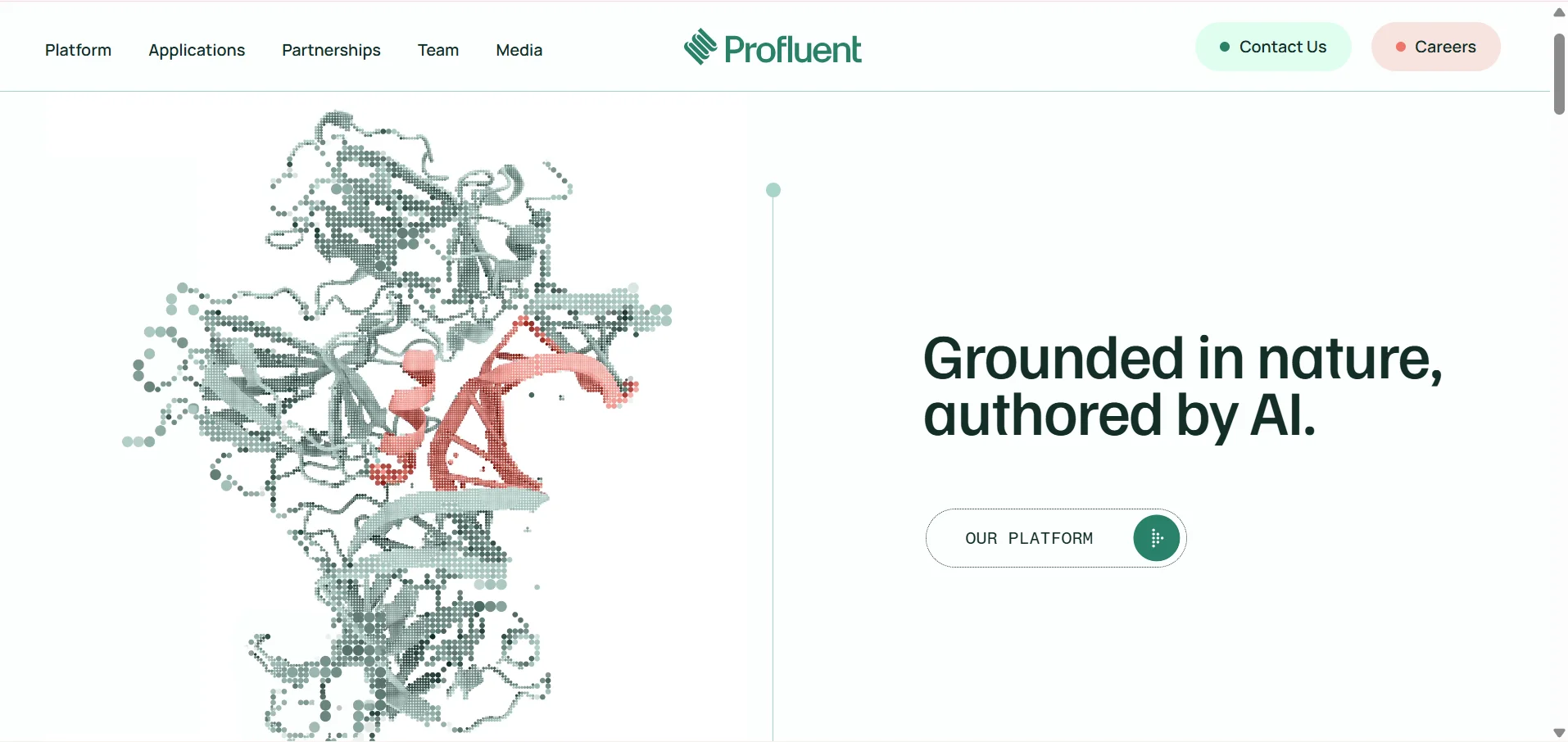
Most people hear “AI” and think chatbots or image generators. But there’s a whole other world growing in the background, and it’s not about writing text at all. It’s about writing biology. Profluent, a California startup, has been building AI models that design completely new proteins; not copies, not tweaks, but original biological tools the world has never seen. They just raised more than 106 million dollars to scale this work, and it’s one of those moments where you pause a bit and think, “Wait… AI can design life molecules now?”
It’s strange at first, because protein design sounds like something that should stay trapped inside universities and giant pharma labs. Yet here we are: an AI company treating biology like code. And instead of talking about paragraphs or prompts, they talk about billions of protein sequences and generative models that behave almost like text models do. It feels like a side of AI most people haven’t even explored yet.
AI That Creates New Proteins Instead Of Text
Profluent’s whole idea is simple enough to explain over coffee. The same way ChatGPT learns patterns in language, their models learn patterns in proteins. Except proteins aren’t sentences. They’re tiny machines that make your cells work. They fight infections, digest food, repair tissue, run your metabolism and basically keep life running.
So Profluent trains large generative models on huge protein datasets, more than 115 billion sequences, according to the company, and then asks the AI to design new proteins with specific behaviours.
Think of it like telling an AI:
“Create a protein that can fix this kind of mutation,”
or
“Design a molecule that can bind to this target,”
and watching it generate possibilities that nature never got around to trying.
It sounds so much like sci-fi, but the logic is the same as language models. The AI doesn’t need to understand biology, it just needs to learn the patterns well enough to propose designs that scientists can test.
Why Big Investors Just Put 106 Million Dollars Into This
For a company that most people haven’t heard about, Profluent has some very loud believers. Their latest funding round pulled in more than 106 million dollars, led by Altimeter Capital and Bezos Expeditions. Yes, that Bezos. The list includes a mix of biotech and deep-tech backers who usually look for ideas that feel less like apps and more like platforms. And that’s exactly how Profluent positions itself, as the foundation layer for a new generation of biology tools.
Investors aren’t throwing that kind of money at a story. They’re betting on the idea that if AI can reliably suggest new proteins, everything from drug discovery to agriculture could speed up. You get shorter timelines, cheaper experiments and brand-new biological parts that would have taken years to design manually.
It’s not guaranteed, of course, but the fact that top investors are leaning in tells you this area is shifting from “maybe one day” to “okay, let’s build this for real.”
How They Train These Models And What They’ve Already Built
The cool part is how Profluent actually trains these models. They use a dataset of about 115 billion protein sequences, which is insane when you think about it. Imagine feeding an AI every recipe ever written, plus millions more that humans never invented, and then asking it to design new dishes. That’s basically what they’re doing, except the recipes here are the instructions for how life works.
One of their biggest flexes is something called OpenCRISPR-1. It’s an AI-designed gene editor they released as an open project so researchers could use it freely. They’ve also been working with the Rett Syndrome Research Trust to design new editing tools for a rare neurological condition. For a company this young, it’s a surprisingly concrete set of projects. It makes the whole thing feel less like future hype and more like “oh, they’re already doing this.”
Why This Is Interesting For Everyday People
The easiest way to think about this is to imagine what happens when designing a new protein becomes as normal as writing a line of code. It opens the door to things most people don’t realise are possible yet. You could have medicines that are designed faster because the AI proposes better starting points. You could have enzymes that break down plastic or clean up oil spills. You could have crops that survive heat waves without needing years of breeding. And you could have gene-editing tools that are much more precise for rare conditions.
None of this means these products will appear overnight. Biology still takes time. But the idea that an AI can sketch out the first draft, the piece that used to take scientists years of trial and error, changes the pace. It means people might see the impact of this kind of technology sooner than they expect, even if they never hear the word “protein sequence” again.
A Company Betting Big On Programmable Biology
So that’s Profluent. A startup treating biology the way tech companies treat software. Not in a flashy “sci-fi robot doctor” way, but in the calm, methodical sense of building tools that make scientists faster. They’re not promising miracles. They’re building infrastructure. And sometimes that’s where the biggest shifts start.
It’s one of those fascinating corners of AI that sits outside the usual headlines. While everyone debates chatbots, companies like Profluent are working in the background, designing the biological tools that could shape the next decade of medicine, agriculture and manufacturing. It’s early, but it’s real. And definitely worth paying attention to.